
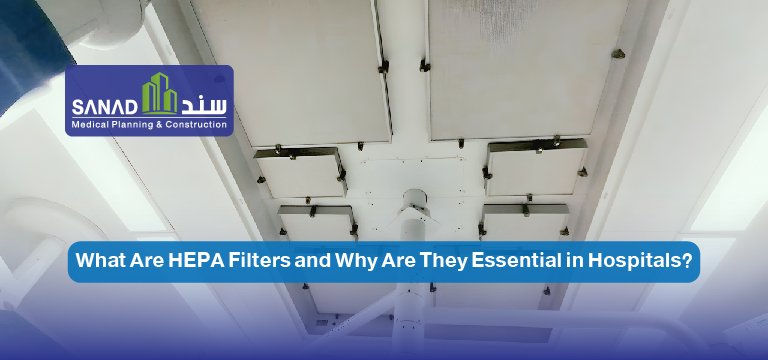
When a patient enters an operating theater, they trust that everything around them is sterile and clean — the instruments, the medical staff, and even the air they breathe. This trust relies on an invisible engineering backbone: HEPA filters. These are not merely ventilation components to be replaced upon wear; they represent the primary line of defense against post-operative infections and stand as one of the most critical standards evaluated by the Saudi Central Board for Accreditation of Healthcare Institutions (CBAHI) during field surveys. To guarantee the safety of this complex framework, partnering with the best specialized medical engineering and ventilation company is the only assurance for secure hospital operations.
Sanad Medical, the leading specialized partner in equipping and qualifying healthcare facilities across the Kingdom, outlines in this comprehensive guide why HEPA filters are an absolute necessity rather than an engineering choice, how they function within clinical environments, the distinct classifications among them, and why their integration must begin at the initial architectural design phase rather than the procurement stage.
First: Understanding HEPA Filters
The term HEPA stands for High-Efficiency Particulate Air. A filter carrying this medical-grade designation is engineered at a microscopic level to trap the finest microbial and airborne particles. It targets the exact particle size that represents the most difficult diameter to capture in the physics of air filtration — medically recognized as the most penetrating particle size.
While larger particles are easily intercepted due to their mass and smaller particles are trapped due to their erratic, random movement, these specific microscopic particles represent the critical threshold in filtration. Designing the medical standard around this specific size guarantees that any particles larger or smaller are captured with absolute efficiency.
Second: How HEPA Filters Function: Three Simultaneous Mechanisms
The foundational principle of HEPA filtration relies on multiple simultaneous mechanical actions occurring within the microscopic fiber matrix:
- Interception: Particles traveling close to the specialized glass fibers adhere to them and become trapped. This mechanism handles most medium-sized particles that follow the airstream smoothly.
- Impaction: Larger particles, possessing greater mass, cannot adapt to changes in air direction as they approach the fibers. Consequently, they collide directly with the filter media and are permanently retained while the clean air continues forward.
- Diffusion: Ultra-fine, microscopic particles move in an erratic, random manner. This erratic behavior significantly increases the probability that they will collide with the filtration fibers and adhere to them.
The integration of these three mechanisms grants the filter exceptional capturing power against an extensive spectrum of contaminants: bacteria, fungal spores, airborne viruses, fine dust, and bio-particles invisible to the naked eye.
Third: Classifications of HEPA Filters in Healthcare Facilities
Not all HEPA filters are identical. In clinical environments, the distinction between one class and another dictates the level of safety provided to the patient based on departmental sensitivity:
| Filter Classification | Hydraulic Efficiency Level | Primary Clinical Application |
| HEPA H13 | High-Efficiency Standard Filtration | General operating rooms and standard intensive care units. |
| HEPA H14 | Ultra-Fine Precision Filtration | Critical surgical theaters, burn units, and organ transplant wards. |
| ULPA | Absolute Maximum Filtration | High-risk isolation rooms, oncology units, and immunodeficiency wards. |
Fourth: Strategic Deployment of HEPA Filters Within Hospitals
A HEPA filter is not a standalone appliance placed in the corner of a room; it is an integrated component within a highly complex mechanical Heating, Ventilation, and Air Conditioning (HVAC) system designed specifically for each medical zone:
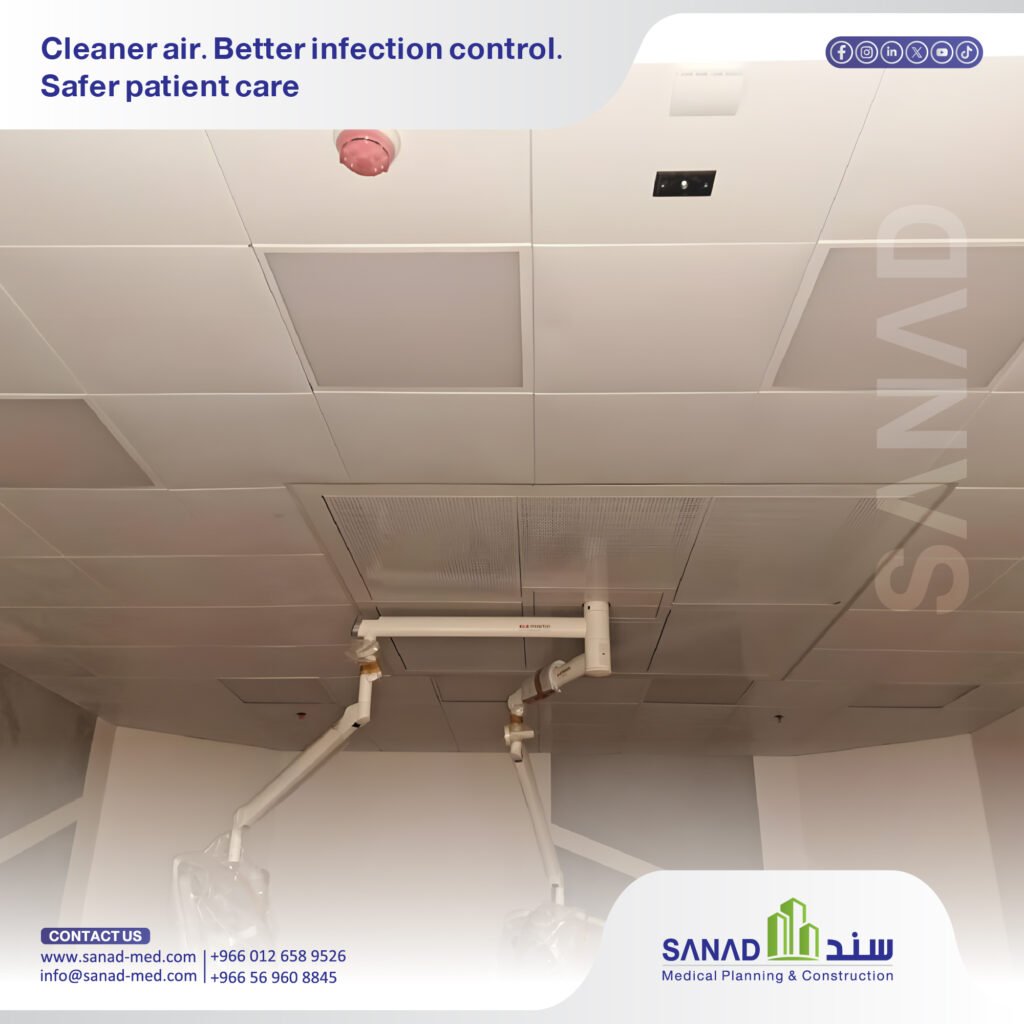
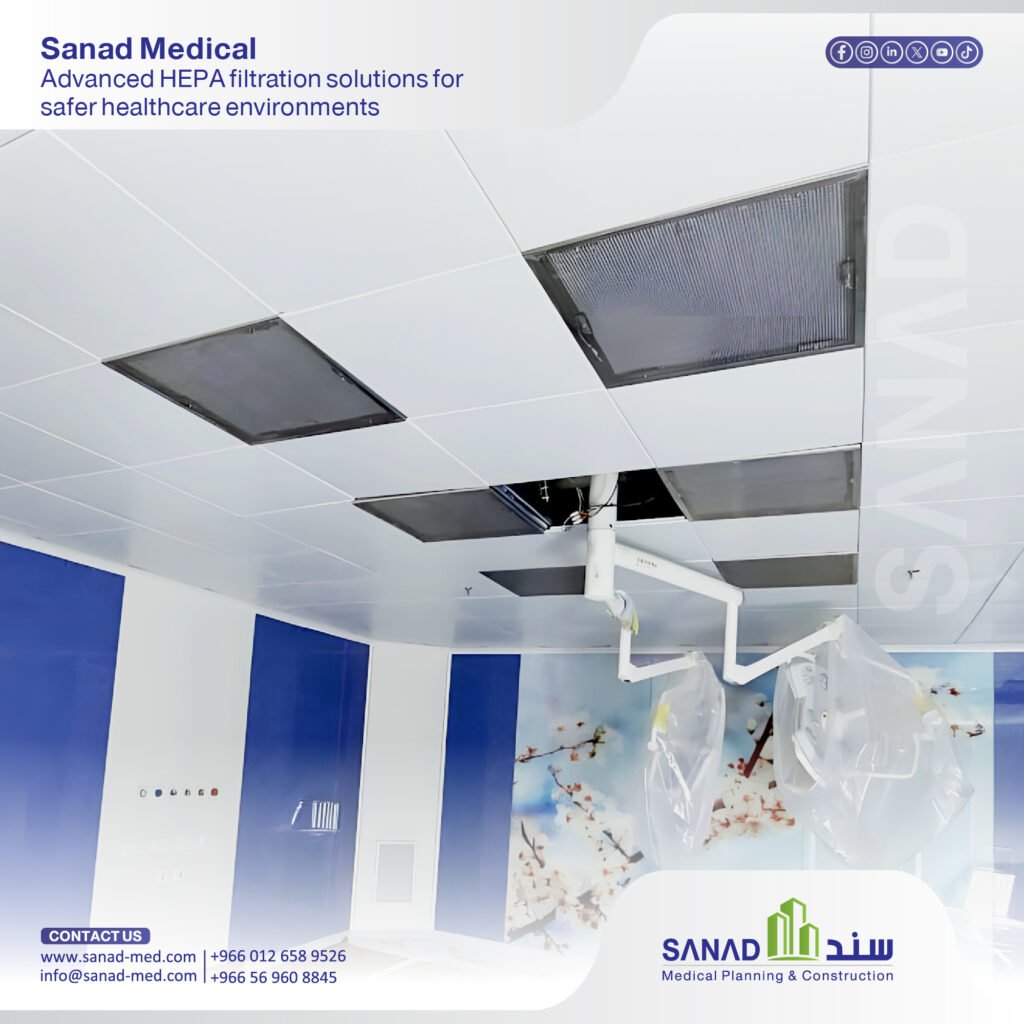
- The Operating Theater: Filters are installed at the terminal end of the Air Handling Units (AHU) and directed toward the patient and the surgical field via a Laminar Flow system. This system delivers ultra-clean air in a uniform, unidirectional stream that isolates the surgical site from potential contamination.
- Intensive Care Units (ICU): These systems elevate air quality in environments housing patients in highly compromised immunological states who are exceptionally vulnerable to healthcare-acquired infections.
- Negative Pressure Isolation Rooms: Air exhausted from the isolation suite must pass through terminal filters before being discharged, preventing pathogens from escaping into public corridors.
- Positive Pressure Protective Environments: Reserved for highly immunocompromised patients; inbound air passes through the system to shield them from any external microscopic threats.
Fifth: Direct Compliance with CBAHI and SFDA Standards
Deploying HEPA filters is not an optional engineering choice; it is a direct regulatory mandate across the Kingdom’s healthcare licensing frameworks:
- Surveyors from CBAHI audit the performance of infection control systems and medical ventilation during field inspections. Any deficiency in filtration directly compromises the facility’s standing in core patient safety modules (Core Standards), which permit no margin for error.
- The Saudi Food and Drug Authority (SFDA) reviews certified ventilation systems as part of institutional environmental safety, meaning missing or non-compliant filtration specifications will halt final operational licensing.
Sixth: Critical Errors in Hospital HEPA Filter Management
- ❌ Selecting an incorrect filtration class for the medical space, such as installing a standard filter in an advanced transplant suite requiring absolute purification.
- ❌ Failing to conduct rigorous housing and perimeter leak tests immediately following installation, allowing unfiltered bypass air to escape through the frame edges.
- ❌ Delaying periodic replacements or attempting to clean the media; medical-grade HEPA filters must be entirely replaced and are never washable.
- ❌ Disregarding the balance between filter resistance and fan capacity within the air handling network, leading to a failure in maintaining mandatory room pressures.
- ❌ Neglecting the maintenance and timely replacement of pre-filters (Pre-filters), which overburdens the main filter and shortens its operational lifecycle.
About Sanad Medical
Sanad Medical is recognized as the premier specialized expert in medical engineering and comprehensive healthcare facility outfitting across the Kingdom of Saudi Arabia. The company delivers fully integrated engineering solutions, beginning with technical consultations for site evaluation, specialized radiation shielding designs certified by medical physicists, and the supply and installation of pure lead sheeting, lead-lined glass, and comprehensive magnetic shielding for diagnostic suites. The extensive field experience of Sanad Medical guarantees that your facility’s mechanical and medical infrastructure is executed flawlessly from the first attempt, preventing costly structural re-works and preparing your facility to pass final inspections by the Ministry of Health (MOH) and the Nuclear and Radiological Regulatory Commission (NRRC) rapidly and seamlessly.
Conclusion
Clinical air purity and filtration efficiency represent the thin boundary separating a patient recovering safely from one facing the severe risks of surgical site infections. Proactive, integrated planning of your medical ventilation networks safeguards your patients and protects your official institutional accreditations.
The dedicated engineers and technical experts at Sanad Medical are fully prepared to design, supply, and validate advanced ventilation networks and HEPA filtration systems tailored to your facility in complete alignment with all regulatory codes.
Frequently Asked Questions (FAQ)
- Q: How does Sanad Medical guarantee the absolute performance of HEPA filters post-installation in surgical suites?
- A: We do not stop at physical installation; our technical teams perform specialized aerosol integrity tests to verify airtight sealing around the filter frame, alongside measuring Laminar Flow velocities to ensure complete compliance with positive pressure standards mandated by CBAHI.
- Q: What criteria determine the exact timeframe for replacing medical-grade HEPA filters?
- A: The definitive metric is the continuous monitoring of the mechanical differential pressure gauge. As the filter media accumulates microscopic particulates, resistance rises, triggering a clear operational indicator that a structural replacement is required to maintain system equilibrium.
- Q: Can certified medical HEPA filters be cleaned using compressed air or water washes to extend their use?
- A: Absolutely not. Medical-grade filters are strictly designed for single-use lifecycles and must be discarded upon saturation. Any attempt at cleaning mechanically alters and ruptures the delicate microfiber matrix, destroying its filtration capacity and allowing microbes to pass freely.
- Q: What role do pre-filters play within the terminal medical ventilation system?
- A: Pre-filters act as the initial structural barrier, capturing large dust fractions, lint, and macro-particles before the air stream reaches the primary terminal filters. This foundational stage prevents premature clogging of the high-efficiency system, extending both its operational life and economic efficiency.